
Key takeaways
- New salad and sandwich prep fridge prices (2026 AUD): single-door $1,000-$2,500, two-door $2,000-$4,000, three-door $3,000-$5,500.
- Used prep fridges: $500-$2,500 depending on door count, compressor condition and brand.
- Annual energy costs: $400-$1,200 for a two-door unit running 24/7 at current Australian commercial electricity rates.
- GN pan configuration drives daily prep efficiency: a two-door unit holds 4-6 x 1/1 GN pans plus 6-9 x 1/6 or 1/3 topping pans. Underspecifying pan capacity means restocking mid-service.
- If your kitchen makes 80+ sandwiches or salads per day: a two-door or three-door unit pays back the upgrade from single-door within the first month through faster prep and reduced ingredient waste.
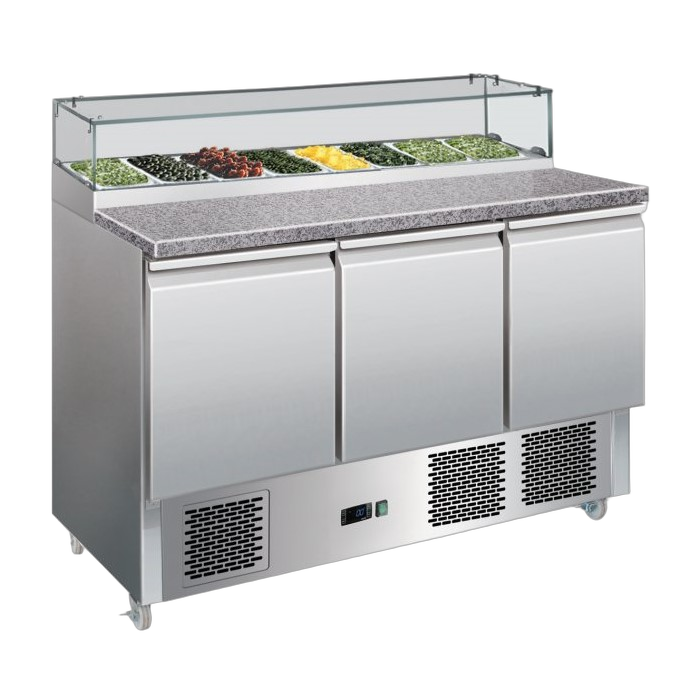
- Glass canopy models add $200-$600 to purchase price but keep exposed toppings within FSANZ temperature compliance without cling wrapping between orders.
- All prep fridges must maintain food below 5°C under Australian Food Safety Standards. Units with digital temperature displays and alarms add $100-$300 but simplify health inspection compliance.
- Salad and sandwich prep fridges are available from verified Australian suppliers on HospitalityHub.
Introduction
A salad and sandwich prep fridge is one of the most frequently used pieces of equipment in any cafe, sandwich bar, salad outlet or fast-casual kitchen - and one of the most frequently underspecified. A $1,500 single-door unit holding 3 x 1/1 GN pans and 4 topping wells will bottleneck a kitchen making 100+ sandwiches per day, forcing mid-service restocks that slow ticket times and increase ingredient waste from temperature breaks. The right-sized unit eliminates that bottleneck for an additional $1,000-$2,000 in purchase price - a gap that pays for itself within weeks.
This guide breaks down the full cost of owning a salad and sandwich prep fridge in Australia: purchase price by door count, annual energy and maintenance costs, GN pan configuration economics and the daily volume threshold where stepping up in size makes financial sense. If you are comparing supplier quotes, get quotes for salad and sandwich prep fridges on HospitalityHub to benchmark pricing from multiple verified suppliers.
Operations that typically invest in prep fridges:
- Sandwich bars and sub shops with high-volume made-to-order production
- Cafes and lunch bars running salad bowls, wraps and panini programs
- Fast-casual and QSR kitchens with assembly-line prep stations
- Hotel and resort kitchens with buffet or room-service salad prep
- Catering kitchens pre-assembling sandwich and salad platters for events
Choose your door count and pan configuration
Before costing anything, confirm the door count and GN pan capacity your daily prep volume requires. Your choice here sets your price bracket and determines whether the unit keeps up with service or creates a bottleneck.
Configuration | Price Range (AUD) | Best For |
|---|---|---|
Single-door (2-3 x 1/1 GN + 3-4 topping pans) |
$1,000-$2,500 |
Small cafes, food trucks, low-volume operations under 50 sandwiches/day |
Two-door (4-6 x 1/1 GN + 6-9 topping pans) |
$2,000-$4,000 |
Sandwich bars, lunch cafes, QSR kitchens doing 50-150 units/day |
Three-door (6+ x 1/1 GN + 9-18 topping pans) |
$3,000-$5,500 |
High-volume sandwich shops, multi-station kitchens, catering operations, 150+ units/day |
If your kitchen consistently makes fewer than 50 sandwiches or salads per day, a single-door unit keeps capital under $2,500. Above 80 units per day, a two-door is the minimum specification - the additional pan capacity eliminates mid-service restocking that costs 15-20 minutes per restock in lost prep time and temperature compliance risk.
Evaluate the key cost specifications
With your door count confirmed, these are the specifications that drive total cost of ownership beyond the purchase price.
Specification | Typical Range | Cost Impact |
|---|---|---|
Compressor type |
Standard or heavy-duty (tropical-rated) |
Tropical-rated compressors add $200-$500 but maintain temperature in hot Australian kitchens above 32°C ambient - standard units struggle above 38°C |
Cooling system |
Static (natural) or fan-forced |
Fan-forced adds $150-$400 but delivers even cooling across all pan positions, reducing cold spots and ensuring consistent temperature during high-use periods |
Glass canopy |
With or without curved glass sneeze guard |
Adds $200-$600 - required for exposed-topping operations to maintain temperature compliance without cling wrapping between orders |
GN pan depth |
65 mm, 100 mm or 150 mm |
Deeper pans hold more product per restock cycle - 150 mm pans reduce restocking frequency by 30-50% vs 65 mm for high-use ingredients |
Temperature display |
Analogue dial or digital with alarm |
Digital with alarm adds $100-$300 - simplifies health inspection compliance and provides a dated temperature log for FSANZ record-keeping |
Construction material |
Stainless steel interior and exterior |
Full stainless steel adds $200-$500 over partial-stainless models but lasts longer, cleans easier and meets food safety inspection standards in all states |
Understand the full cost breakdown (2026 prices)
Purchase price is only part of the picture. Here is the full cost of owning a salad and sandwich prep fridge in Australia.
Category | Cost Range (AUD) | Typical Configuration |
|---|---|---|
New single-door |
$1,000-$2,500 |
2-3 x 1/1 GN, static cooling, analogue temp, no canopy |
New two-door |
$2,000-$4,000 |
4-6 x 1/1 GN, fan-forced, digital temp, glass canopy optional |
New three-door |
$3,000-$5,500 |
6+ x 1/1 GN, fan-forced, digital temp with alarm, glass canopy |
Used |
$500-$2,500 |
All sizes - price depends on compressor age, seal condition and brand |
Annual energy |
$400-$1,200 |
24/7 operation at 1.5-4.0 kWh/day depending on size and ambient temperature |
Annual maintenance |
$200-$600 |
Condenser cleaning, door seal replacement, thermostat check, compressor service |
GN pans (initial set) |
$100-$400 |
Pans typically not included - budget for a full set of 1/1, 1/3 and 1/6 GN pans with lids |
Door seal replacement |
$50-$150 per door |
Every 2-3 years depending on use frequency - worn seals increase energy draw by 15-25% |
The most common mistake is not budgeting for GN pans separately. Most prep fridges ship without pans, and a full set of stainless steel GN pans with lids for a two-door unit adds $150-$300 to the setup cost. The second most common mistake is ignoring door seal condition on used units - a worn seal on a $1,500 used prep fridge increases energy draw by 15-25% and allows temperature to creep above 5°C during peak service, creating a food safety risk that costs far more to fix than the $50-$150 seal replacement. For a two-door unit at $3,000 running 24/7, five-year total cost of ownership totals $5,500-$9,000 including purchase, energy, maintenance and consumables. Get quotes for salad and sandwich prep fridges to compare delivered pricing before finalising your specification.
Plan the asset - depreciation and financing
The ATO assigns an effective life of 10 years for commercial refrigeration equipment. Under diminishing value, the depreciation rate is 20%. Under prime cost, it is 10%. The current instant asset write-off threshold of $20,000 (2026 financial year) covers all salad and sandwich prep fridges outright for eligible small businesses - every unit in this category falls well under the threshold.
For new cafes or sandwich bars where trading volume is unproven, rent-to-own agreements are available from some suppliers and limit capital exposure. Residual values at 5-8 years sit at 10-20% of purchase price for well-maintained units with functioning compressors and intact door seals.
Evaluate suppliers
You are ready to go to market. Use this checklist to assess each supplier against the same criteria.
Factor | What to Ask |
|---|---|
Delivered price |
Total delivered price including glass canopy, GN pans and delivery? |
Pan inclusion |
Are GN pans included in the price or quoted separately? What sizes and depths are supplied? |
Compressor rating |
Is the compressor tropical-rated for Australian kitchen ambient temperatures above 32°C? |
Warranty |
Warranty period for compressor, thermostat, door seals and cabinet? |
Parts availability |
Are replacement door seals, thermostats and compressor parts Australian-stocked? |
Service response |
What is the breakdown response time in your city? A failed prep fridge during service is a food safety shutdown. |
Energy rating |
What is the rated daily kWh? Can the supplier estimate annual energy cost at your local tariff? |
Cooling type |
Is the unit fan-forced or static? Fan-forced is recommended for operations with 8+ topping pans. |
Lead time |
Current delivery lead time? Are ex-demo or display units available for faster delivery? |
Used unit condition |
For used units: compressor age, door seal condition, temperature test results and any remaining warranty? |
Frequently asked questions
How much does a salad and sandwich prep fridge cost in Australia?
New salad and sandwich prep fridges range from $1,000-$2,500 for single-door to $3,000-$5,500 for three-door models in 2026 AUD. Used units are available from $500-$2,500 depending on compressor condition and brand.
What are the annual running costs for a prep fridge?
Annual running costs for a two-door prep fridge total $600-$1,800 covering energy ($400-$1,200) and maintenance ($200-$600). Prep fridges run 24/7 so energy cost is constant year-round regardless of trading hours.
At what daily volume should i upgrade from single-door to two-door?
Once your kitchen consistently makes above 80 sandwiches or salads per day, a two-door unit eliminates mid-service restocking that costs 15-20 minutes per restock. The $1,000-$1,500 upgrade typically pays back within the first month through faster prep and reduced ingredient waste from temperature breaks.
Do GN pans come included with a prep fridge?
Most prep fridges ship without GN pans. Budget $100-$400 for a full set of stainless steel GN pans with lids - confirm pan sizes (1/1, 1/3, 1/6) and depths (65 mm, 100 mm, 150 mm) with your supplier before ordering.
What temperature must a prep fridge maintain under Australian food safety rules?
All prep fridges must maintain food below 5°C under FSANZ Australian Food Safety Standards. Units with digital temperature displays and high-temperature alarms simplify compliance during health inspections and provide a dated temperature log for record-keeping.
What matters most
- Door count and GN pan capacity set your daily prep throughput - underspecifying creates a mid-service bottleneck
- Two-door upgrade pays back within the first month above 80 sandwiches or salads per day
- GN pans are typically not included - budget $100-$400 for a full set
- Annual running costs of $600-$1,800 per unit covering energy (24/7) and maintenance
- Worn door seals increase energy draw by 15-25% and create food safety risk - replace every 2-3 years
- All units qualify for the $20,000 instant asset write-off for eligible small businesses
Most buyers shortlist 2-3 models after getting a quote - if you are within 30 days of purchasing, start the comparison now.
Don't waste time contacting suppliers individually. HospitalityHub gives you direct access to verified Australian salad and sandwich prep fridge suppliers - where hospitality buyers request and compare multiple quotes so they can buy with confidence.
- Get quotes for salad and sandwich prep fridges - contact multiple verified suppliers with a single enquiry
- Compare models - filter by door count, pan capacity and region
- Contact suppliers directly - speak to specialists who service your state
→ Get and compare salad and sandwich prep fridge quotes now → hospitalityhub.com.au/buy/salad-and-sandwich-prep-fridge


-160x160-state_article-rel-cat.png)


-160x160-state_article-rel-cat.jpg)