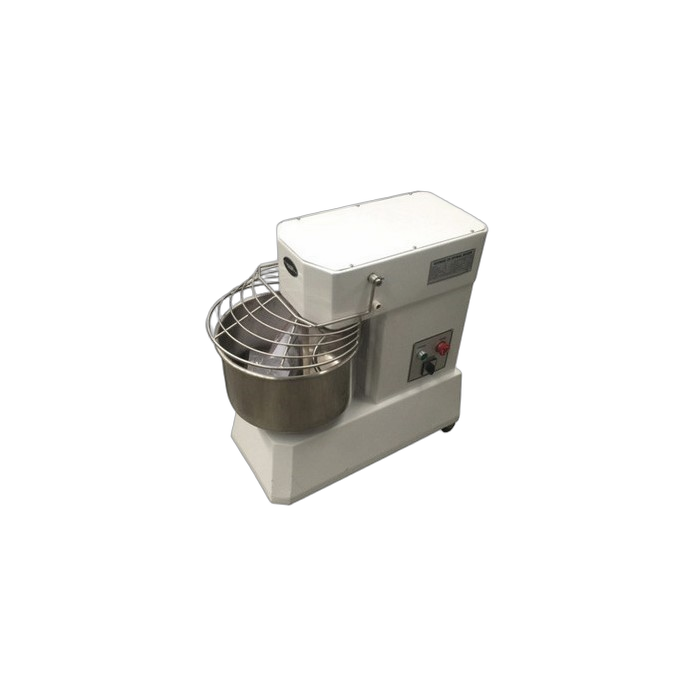

Key takeaways
- Dough speed: Spiral mixers develop full gluten structure in typically 6-10 minutes vs 12-18 minutes on a planetary mixer of equivalent bowl size - 30-50% faster per batch on bread and pizza dough.
- Versatility: Planetary mixers handle whipping, creaming, blending and dough with interchangeable attachments; spiral mixers are dough-only machines.
- Price comparison: Entry-level spiral $2,500-$6,000 vs entry-level planetary $1,200-$4,000 (2026 AUD) - spiral costs more at the same bowl size but produces more dough per hour.
- Heat generation: Spiral mixers generally produces lower friction heat during dough development than planetary during dough development - lower dough temperature means better fermentation control.
- Batch capacity: Spiral mixers typically handle dough at around 40-60% of bowl volume, while planetary mixers are often in the 30-50% range depending on dough type
- Decision threshold: If the majority of your mixer's workload is bread, pizza or heavy dough at 4+ batches/day, spiral is the better investment. If your menu requires whipping, creaming and occasional dough, planetary covers more ground.
- Both spiral and planetary mixers are available from verified Australian suppliers on HospitalityHub - spiral mixers and planetary mixers.
Spiral mixer vs planetary mixer: Which earns its place in your kitchen? (2026 comparison)
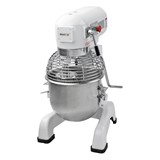
Spiral and planetary mixers solve different production problems, but most Australian bakeries and commercial kitchens buy the wrong one because they compare on bowl size instead of output per hour. A 60L planetary mixer handles a wider range of tasks. A 60L spiral mixer produces more dough in less time with less heat. The right choice depends on what your kitchen actually makes and how much of it runs through the mixer each day.
This comparison guide puts both machines side by side on price, output, running costs, versatility and the decision factors that matter at procurement stage. For the full pricing breakdown on each type, see the spiral mixer price guide or the planetary mixer cost guide.
Operations where this comparison matters most:
- Bakery-cafes producing both bread/pastry dough and cakes/creams daily
- Pizzerias evaluating whether to add a dedicated spiral vs upgrading their planetary
- New kitchen fit-outs with budget for one mixer type only
- In-store supermarket bakeries balancing dough volume with product variety
Compare the core differences
Before comparing costs, confirm which machine type matches your production profile. The table below covers the specifications that drive the decision.
Factor | Spiral Mixer | Planetary Mixer |
|---|---|---|
Mixing action |
Fixed spiral hook, rotating bowl |
Rotating attachment orbits a fixed bowl |
Dough capacity (% of bowl) |
40-60% |
30-50% |
Mix time (bread dough) |
6-10 minutes |
12-18 minutes |
Friction heat |
Low - 2-4°C dough temp rise |
Higher - 5-8°C dough temp rise |
Attachment versatility |
Dough only (spiral hook) |
Dough hook, flat beater, whisk, optional attachments |
Bowl sizes available |
20-300L+ |
5-140L |
Floor footprint (60L model) |
600 × 1,000 mm approx. |
550 × 800 mm approx. |
Evaluate the key specifications
With the core differences clear, these are the specifications that determine which machine delivers better value for your specific operation.
Specification | Typical Range | Buyer Consideration |
|---|---|---|
Motor power (60L class) |
Spiral 1.5-2.2 kW; Planetary 1.1-1.5 kW |
Spiral needs more power per batch but processes faster - net energy per kg of dough is comparable |
Speed settings |
Spiral: 2-speed or VFD; Planetary: 3-4 fixed speeds |
Planetary's multiple speeds suit varied tasks; spiral's two speeds are optimised for dough only |
Output per hour |
Spiral: higher batch throughput per hour Planetary: lower throughput per hour |
Spiral typically produces significantly more dough per hour at the same bowl size, depending on process and dough type |
Dough temperature control |
Spiral: 2-4°C rise; Planetary: 5-8°C rise |
Lower temp rise means longer fermentation window and more consistent crumb structure |
Maintenance intensity |
Spiral: hook + belt; Planetary: gear or belt transmission + attachments |
Spiral has fewer moving parts but hook replacement is a recurring cost; planetary gearbox repair is more expensive when it fails |
Compare the full cost (2026 prices)
Purchase price is only part of the picture. The table below models the full 5-year cost at equivalent bowl sizes.
Category | Spiral Mixer (60L) | Planetary Mixer (60L) |
|---|---|---|
New unit purchase |
$8,000-$15,000 |
$10,000-$18,000 |
Used/refurbished |
$3,000-$8,000 |
$5,000-$10,000 |
Annual running cost (standard use) |
$1,000-$2,000 |
$800-$1,800 |
5-year TCO (purchase + running) |
$13,000-$25,000 |
$14,000-$27,000 |
Cost per kg of dough (at 6 batches/day) |
approximatley $0.04-$0.08/kg |
$0.06-$0.12/kg |
At 6+ batches per day, the spiral mixer's lower per-kg dough cost offsets its higher purchase price within 12-18 months. For a 60L spiral at $8,000-$15,000 or a 60L planetary at $10,000-$18,000, get quotes for spiral mixers or get quotes for planetary mixers to compare pricing from verified Australian suppliers.
Decision framework - spiral vs planetary
Decision Factor | Choose Spiral | Choose Planetary |
|---|---|---|
Primary product |
70%+ of output is bread, pizza or heavy dough |
Mixed menu - dough, cakes, cream, sauces, batters |
Daily batch count |
4+ dough batches per day - speed matters |
Under 4 batches - versatility matters more than speed |
Dough quality |
Fermentation control and consistent hydration are critical (artisan, sourdough) |
Acceptable dough quality is sufficient - not the primary mixer function |
Budget for one machine |
Spiral if dough is the core revenue product |
Planetary if the kitchen needs one machine to do multiple jobs |
Space constraint |
Larger footprint but replaces hand-mixing for large batches |
Smaller footprint at equivalent bowl size |
Growth plan |
Scaling to 80-300L bowl sizes as volume grows |
Max 140L - add a spiral if dough volume exceeds planetary capacity |
Evaluate suppliers
You are ready to go to market. Use this checklist to assess each supplier against the same criteria.
Factor | What to Ask |
|---|---|
Dough output per hour |
What is the maximum dough throughput per hour at my planned batch size and hydration level? |
Motor duty cycle |
Is this motor rated for continuous duty at my planned batch frequency? |
Warranty comparison |
What warranty period and coverage do you offer? Is the motor and gearbox covered separately? |
Spare parts |
Are all wear parts (hooks, belts, beaters, whisks) stocked in Australia? |
Demo or trial |
Can I test the machine with my actual dough recipe before committing? |
Upgrade path |
If I outgrow this model, what is the trade-in or upgrade process? |
Installation |
Is delivery, installation and commissioning included in the quoted price? |
Service coverage |
Do you have service technicians in my state? What is the typical response time? |
Lead time |
Is this model ex-stock in Australia or imported to order? |
Finance |
Do you offer lease, hire-to-own or equipment finance arrangements? |
Frequently asked questions
When should i choose a spiral mixer over a planetary mixer?
Choose spiral when 70%+ of your mixer workload is bread, pizza or heavy dough and you run 4+ batches per day. The faster mix time and lower heat generation produce better dough at higher throughput, which offsets the higher purchase price within 12-18 months.
Can a planetary mixer handle the same dough volume AS a spiral?
At the same bowl size, a planetary mixer handles 20-30% less dough per batch and takes 50-80% longer per mix cycle. A 60L planetary typically produces less dough per hour than a spiral of the same size, often significantly less depending on process.
What is the cost per kilogram of dough for each machine type?
At standard use (6 batches/day on a 60L unit), spiral costs $0.04-$0.08/kg and planetary costs $0.06-$0.12/kg. The gap widens at higher batch volumes because spiral's faster cycle time compounds the per-unit saving.
Can i use one machine for both dough and other mixing tasks?
Only with a planetary mixer. Spiral mixers are dough-only machines with no attachment versatility. If your operation needs whipping, creaming and dough from a single unit, planetary is the only option.
Do both machine types meet Australian commercial kitchen compliance requirements?
Both must comply with AS/NZS 60335-2-14 (food mixer electrical safety), AS/NZS 4024 (machinery guarding) and FSANZ Standard 3.2.3 (food contact materials). Confirm compliance certification with your supplier before purchase.
Summary
- Spiral mixers are faster and can produce more consistent dough quality for bread and pizza applications - but they only do dough
- Planetary mixers are more versatile - dough, cream, batter, sauce - but slower on heavy dough
- At 4+ dough batches/day, spiral's per-kg cost advantage can pay back within approximately 12-18 months depending on utilisation and dough volume
- Planetary is the right choice when the kitchen needs one machine for multiple tasks
- 5-year TCO at 60L is comparable: spiral $13,000-$25,000 vs planetary $14,000-$27,000
- Operations with budget for both should consider a spiral for dough and a smaller planetary for everything else
Don't waste time contacting suppliers individually. HospitalityHub gives you direct access to verified Australian commercial mixer suppliers - where hospitality buyers request and compare multiple quotes so they can buy with confidence.
- Get quotes for commercial spiral mixers - contact multiple verified suppliers with a single enquiry
- Get quotes for commercial planetary mixers - compare pricing, bowl sizes and brands
- Contact suppliers directly - speak to specialists who service your state
→ Get and compare commercial mixer quotes now → https://www.hospitalityhub.com.au/buy/commercial-spiral-mixer