
Key takeaways
- New commercial deck oven prices (2026 AUD): single-deck $3,000-$8,000, two-deck $8,000-$18,000, three-deck or four-deck $15,000-$35,000, high-spec artisan or industrial $35,000-$60,000+.
- Used deck ovens: $2,000-$15,000 depending on deck count, stone condition and brand.
- Annual energy costs: $2,500-$8,000 for a mid-range two-deck oven running 8-12 hours per day, depending on gas vs electric and local tariff.
- Gas vs electric running cost gap: gas deck ovens cost 20-35% less per operating hour than electric equivalents at current Australian commercial tariffs.
- If your bakery produces 100+ loaves per day: a two-deck or three-deck unit typically pays back the upgrade from single-deck within 6-12 months through reduced bake cycles.
- Stone replacement: baking stones last 5-10 years with proper care - replacement cost $500-$2,000 per deck depending on stone type and oven footprint.
- Steam injection systems add $1,500-$4,000 to purchase price but are non-negotiable for artisan bread, sourdough and crusty roll production.
- Both gas and electric commercial deck ovens are available from verified Australian suppliers on HospitalityHub.
Introduction
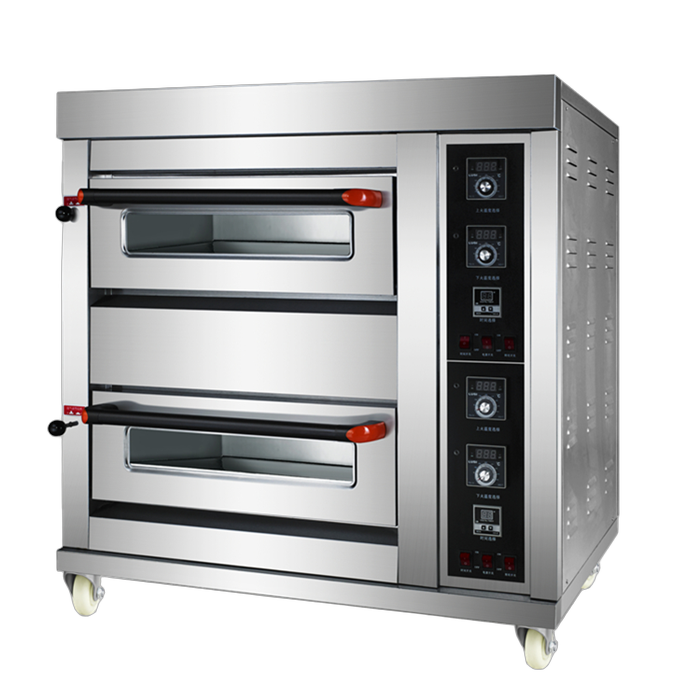
A commercial deck oven is the core production asset in any serious bakery, pizzeria or patisserie. In the Australian market in 2026, prices range from $3,000 for a compact countertop single-deck to over $60,000 for a four-deck gas unit with independent steam injection and stone-base baking across every level. The price gap between tiers is significant, and getting the specification wrong means either paying for unused capacity or bottlenecking production because the oven cannot keep pace with daily demand.
This guide breaks down the full cost of owning a commercial deck oven in Australia: purchase price by deck count and heat source, annual energy and maintenance costs, stone replacement cycles and the daily output threshold where upgrading pays for itself. If you are building a business case or comparing supplier quotes, get quotes for commercial deck ovens on HospitalityHub to benchmark pricing against these ranges.
Operations that typically invest in deck ovens:
- Artisan bakeries producing bread, sourdough and crusty rolls
- Pizza restaurants and takeaway operations requiring stone-base baking
- Patisseries and pastry kitchens running croissant, tart and laminated dough production
- Hotel and resort kitchens with in-house bakery programs
- Supermarket and retail bakeries producing fresh bread throughout the day
Choose your deck count
Before costing anything, confirm the deck count your production volume requires. Your choice here sets your price bracket and most of the running costs that follow.
Configuration | Price Range (AUD) | Best For |
|---|---|---|
Single-deck (electric) |
$3,000-$8,000 |
Cafes, small pizza shops, low-volume bakeries under 50 loaves/day |
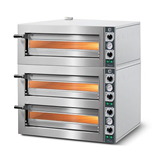
Two-deck (gas or electric) |
$8,000-$18,000 |
Mid-volume bakeries, pizzerias, hotel kitchens producing 50-150 loaves/day |
Three-deck or four-deck (gas or electric) |
$15,000-$35,000 |
Production bakeries, multi-product lines, 150-400+ loaves/day |
High-spec artisan or industrial |
$35,000-$60,000+ |
Large-scale artisan bakeries, thermal oil systems, modular production lines |
If your daily output stays below 50 loaves or equivalent, a single-deck keeps capital under $8,000. If you are producing above 100 units per day across bread and pastry, budget for a two-deck minimum - the reduced bake cycle count pays back the price difference within two to three quarters.
Evaluate the key cost specifications
With your deck count confirmed, these are the specifications that drive total cost of ownership beyond the sticker price.
Specification | Typical Range | Cost Impact |
|---|---|---|
Heat source |
Gas (natural or LPG) or electric (single-phase or three-phase) |
Gas runs 20-35% cheaper per hour but adds $1,000-$3,000 in installation (licensed gasfitter, compliance certificate) |
Baking area per deck |
0.5 m² to 2.0 m² |
Larger stone area = more product per bake cycle = fewer cycles per day = lower energy cost per unit |
Max temperature |
300°C-450°C |
Pizza operations need 400°C+, bread bakeries operate at 220-280°C - overpaying for temperature you do not use adds $2,000-$5,000 |
Steam injection |
Manual, semi-auto or fully automatic per deck |
Adds $1,500-$4,000 to purchase price - required for crusty bread, optional for pizza and pastry |
Stone type |
Refractory, cordierite or ceramic |
Replacement cost $500-$2,000 per deck every 5-10 years - cordierite lasts longest but costs more upfront |
Insulation quality |
Standard vs high-density |
High-density insulation reduces heat loss by 15-25%, lowering energy cost $500-$1,500 per year on high-use ovens |
Understand the full cost breakdown (2026 prices)
Purchase price is only part of the picture - most cost models that get rejected at approval stage have missed the running cost layer. Here is the full breakdown.
Category | Cost Range (AUD) | Typical Configuration |
|---|---|---|
New single-deck electric |
$3,000-$8,000 |
Countertop or compact floor-standing, single-phase, no steam |
New two-deck (gas or electric) |
$8,000-$18,000 |
Floor-standing, independent deck controls, optional steam |
New three/four-deck |
$15,000-$35,000 |
Production-grade, three-phase electric or gas, steam per deck |
New high-spec artisan |
$35,000-$60,000+ |
Thermal oil, modular, programmable bake profiles, full steam |
Used deck oven |
$2,000-$15,000 |
All configurations - price depends on age, stone condition and service history |
Annual energy (electric, two-deck) |
$4,000-$8,000 |
8-12 hours/day operation at $0.30-$0.40/kWh commercial rate |
Annual energy (gas, two-deck) |
$2,500-$5,500 |
8-12 hours/day operation at current commercial gas rates |
Annual maintenance |
$800-$2,500 |
Thermostat calibration, element or burner inspection, door seal replacement, gas safety cert |
Stone replacement (per deck) |
$500-$2,000 |
Every 5-10 years depending on stone type and daily thermal cycling |
The most common mistake is underestimating energy costs on electric deck ovens. A two-deck electric unit drawing 12-18 kW and running 10 hours per day costs $13-$26 per day in electricity alone at typical NSW or VIC commercial rates. Over a year, that is $4,700-$9,500 - often more than the annual repayment on the oven itself. For bakeries running above 8 hours daily, gas delivers a measurably lower per-bake cost. For a two-deck gas oven at $15,000 running 10 hours per day six days per week, the break-even against a comparable electric unit typically occurs within 18-24 months on energy savings alone. Get quotes for commercial deck ovens to compare delivered pricing from multiple suppliers before finalising your cost model.
Plan the asset - depreciation and financing
The ATO assigns an effective life of 10 years for commercial baking ovens. Under diminishing value, the depreciation rate is 20%. Under prime cost, it is 10%. The current instant asset write-off threshold of $20,000 (2026 financial year) covers most single-deck and many two-deck units outright for eligible small businesses. For a deeper look at equipment finance structures available to hospitality businesses, see the prover deck oven buying guide on HospitalityHub which covers lease-to-own and chattel mortgage options.
For multi-deck units above $20,000, chattel mortgage gives immediate ownership and GST recovery. Operating leases suit new bakeries where production volume is still being validated - a 12-month exit clause limits capital exposure while you prove throughput. Residual values for well-maintained deck ovens at 8-10 years sit at 10-20% of purchase price, with premium European brands holding value better than entry-level imports.
Evaluate suppliers
You are ready to go to market. Use this checklist to assess each supplier against the same criteria.
Factor | What to Ask |
|---|---|
Delivered price |
What is the total delivered price including stone base, steam system and commissioning? |
Installation |
Is installation included? For gas units, does the quote cover licensed gasfitter and compliance certificate? |
Warranty |
What is the warranty period for heating elements, thermostats, steam system and stone? |
Parts availability |
Are replacement stones, elements, door seals and thermostats held in Australian stock? |
Service network |
Do you have service technicians in our state? What is the standard response time for breakdowns? |
Energy rating |
What is the kWh or MJ/h rating per deck? Can you provide annual energy cost estimates for our operating hours? |
Demo or trial |
Can we trial the oven or visit a reference site running the same model before committing? |
Lead time |
What is the current delivery lead time? Are ex-demo or display units available sooner? |
Finance options |
Do you offer in-house finance, chattel mortgage facilitation or rent-to-own structures? |
Used unit history |
For used ovens: can you provide full service records, stone condition report and remaining element life? |
Frequently asked questions
How much does a new commercial deck oven cost in Australia in 2026?
New deck ovens range from $3,000-$8,000 for a single-deck electric to $35,000-$60,000+ for a high-spec multi-deck artisan unit with steam injection. The primary price driver is deck count - each additional deck adds $4,000-$10,000 depending on the heat source and stone specification.
Is a gas or electric deck oven cheaper to run?
Gas deck ovens cost 20-35% less per operating hour than electric equivalents at current Australian commercial tariffs. A two-deck gas oven running 10 hours per day typically saves $1,500-$3,000 per year in energy costs compared to a similarly sized electric unit.
At what daily output does upgrading from single-deck to two-deck pay back?
Once your bakery consistently exceeds 80-100 loaves or equivalent per day, the reduced number of bake cycles on a two-deck unit recovers the $5,000-$10,000 price premium within 6-12 months. Below 50 units per day, a single-deck is adequate and the upgrade does not deliver meaningful payback.
How often do baking stones need replacing?
Baking stones last 5-10 years under normal commercial use, depending on daily thermal cycling and cleaning practices. Replacement cost runs $500-$2,000 per deck - cordierite stones last longer than refractory but cost 30-50% more upfront.
What compliance is required for a gas deck oven installation in Australia?
Gas deck ovens must be installed by a licensed gasfitter and certified compliant under AS/NZS 5601 (gas installations). Annual gas safety certification is required in most states, and commercial kitchen ventilation must meet local council and building code requirements.
What matters most
- Deck count is the primary price driver - each additional deck adds $4,000-$10,000 to purchase price
- Gas ovens save 20-35% on energy per operating hour vs electric at current Australian commercial rates
- Annual running costs of $3,300-$10,500 per oven covering energy, maintenance and consumables
- Upgrading from single to two-deck pays back within 6-12 months above 100 loaves/day
- Steam injection adds $1,500-$4,000 but is required for artisan bread production
- ATO effective life of 10 years - instant asset write-off covers most single and two-deck units
Most buyers shortlist 2-3 models after getting a quote - if you are within 60 days of purchasing, start the comparison now.
Don't waste time contacting suppliers individually. HospitalityHub gives you direct access to verified Australian commercial deck oven suppliers - where hospitality buyers request and compare multiple quotes so they can buy with confidence.
- Get quotes for commercial deck ovens - contact multiple verified suppliers with a single enquiry
- Compare models - filter by deck count, heat source and region
- Contact suppliers directly - speak to specialists who service your state
→ Get and compare commercial deck oven quotes now → hospitalityhub.com.au/buy/commercial-deck-oven